What Does Limited Edition Actually Mean on a Watch?

In short: a limited edition watch is one made in a fixed, stated quantity that will not be increased. The strongest version is a numbered limited edition, where each watch carries its own number, such as 1 of 125, and the design is never remade. Before you buy, check how many exist, whether the number appears on the watch itself and whether the brand has promised never to produce it again.
Why the phrase is so confusing
"Limited edition" is one of the most used phrases in watch marketing, and one of the least regulated. There is no industry body that decides what counts. One brand might use it for a run of 50 individually numbered pieces, while another uses it for a colour that will be sold for a season and then quietly replaced. Both can call their watch limited, and both can be telling the truth in a narrow sense.
That is why it pays to understand the different kinds of "limited" you will come across, and the simple questions that separate genuine scarcity from a sales label.
The three kinds of limited you will see
Numbered limited editions
This is the clearest and most honest form. The brand announces a fixed total, such as 125 pieces, and every watch is given its own number within that total. The number is usually marked on the case back, the dial or the side of the case, so each watch can be identified as, for example, 1 of 125 or 087 of 125. Once every number has been sold, the edition is closed.
Because each piece is counted, a numbered edition is easy to verify. You know exactly how many exist, and you know where yours sits within the run.
Limited production
Some watches are described as limited production or a limited run. This usually means the brand intends to make a smaller quantity than normal, but the individual watches are not numbered and the total may not be published. These watches can still be genuinely scarce, but you are relying on the brand's word rather than a number you can see.
Special editions
A special edition is usually a variation on an existing model: a new dial colour, a different strap or a commemorative design for an event. Special editions are often available for a limited time rather than in a limited quantity. If demand is strong, nothing stops the brand making more while the window is open. That does not make them bad watches, but "special" and "limited" are not the same promise.
What to check before you buy
When a watch is described as limited, these four questions tell you almost everything you need to know.
1. Is it numbered?
A numbered edition gives each watch its own identity. If there is no number, ask what "limited" refers to: a quantity, a time window or simply a smaller batch than usual.
2. How many will be made?
A genuine limited edition states its total up front. Be wary of vague phrases like "strictly limited" or "while stocks last" with no figure attached. A clear number is a sign the brand is willing to be held to it.
3. Is the number on the watch itself?
A number printed on a certificate or the box is nice, but certificates get lost and boxes get stored away. A number engraved on the watch stays with it for life, which matters if you ever pass it on or simply want to know which piece you own years from now.
4. Will it be made again?
This is the question that matters most and is asked least. Some brands release a "limited" model, sell it out, then bring back something nearly identical a year later with a small change. Look for a clear commitment that the design will not be reproduced once the edition is closed, and look for evidence that the brand has kept that promise with past models.
Why numbered editions appeal to collectors
For many collectors, the attraction of a numbered limited edition is less about rarity for its own sake and more about knowing exactly what you own. A watch marked 1 of 125 is a specific object, not one unit among thousands. It has a place in a finite story, and that story has an ending.
There is also a quieter benefit. A small, numbered run tends to encourage care, because each piece is going to a single owner who knows their number. If you are weighing up whether that is worth paying for, our honest guide on whether limited edition watches are worth it goes further into value, scarcity and personal meaning.
It also helps to know the language. Terms like edition size, case back, movement and jewels come up constantly when reading about limited releases, and our guide to watch terms every new collector should know explains them in plain English.
How Hartley does limited editions
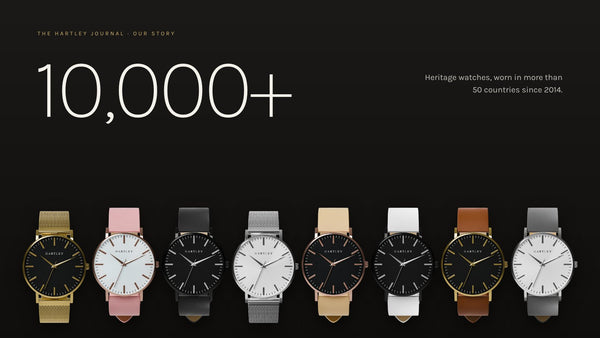
Hartley began in 2014, and our watches are assembled in Australia. As we move towards exclusively numbered limited editions, we have tried to answer all four of the questions above as plainly as we can.
Numbered, with a stated total
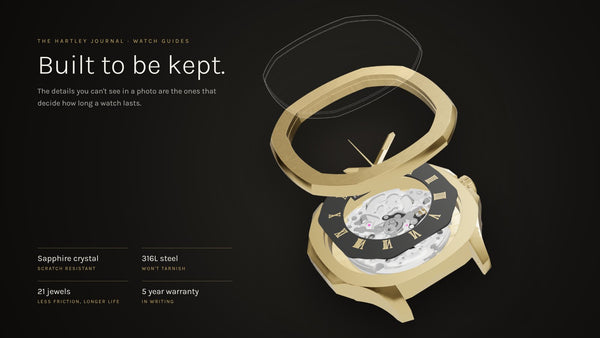
The Legacy is our automatic skeleton watch, and each of its four case colours (gold, silver, black and rose gold) is a numbered limited edition of 125 pieces. That means every Legacy is 1 of 125 within its colour.
You choose your number, and it is engraved on the watch
Rather than receiving whatever number comes next, you choose your own number when you order. It is then engraved on the side of the case, so it stays with the watch rather than living only on paper. If you are unsure which number to pick, our guide on how to choose your Legacy edition number walks through the options.
Never made again
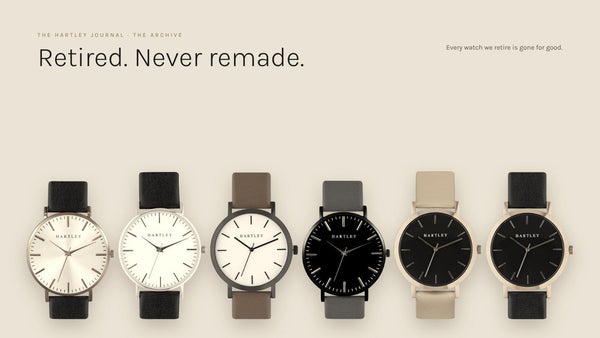
Once a Legacy colour sells out, it will never be made again. This is not a new idea for us. Retired Hartley ranges are never remade, and they live on in the Hartley Archive, a record of the watches that came before. You can read more about why we keep it in our post on the Hartley Archive.
The same applies to the Heritage, our original minimalist watch. The current run of the Heritage collection is the final batch, and it will not be made again.
A quick checklist
- Numbered: each watch carries its own number within the edition.
- Stated total: the edition size is published before you buy.
- On the watch: the number is marked on the watch itself, not only on paperwork.
- Not remade: the brand commits to never producing the design again, and has a record of keeping that promise.
If a watch ticks all four, it is a limited edition in the fullest sense of the phrase. If you would like to see how this looks in practice, the Legacy collection shows each colour of the numbered edition side by side.
Frequently asked questions
Is a limited edition watch always numbered?
No. Some limited editions are numbered and some are not. A numbered edition gives each watch its own number within a stated total, which makes it the easiest kind to verify.
What does 1 of 125 mean on a watch?
It means the watch belongs to an edition of 125 pieces in total. On a Hartley Legacy, the edition is 125 pieces per case colour, and your chosen number is engraved on the side of the case.
What is the difference between a limited edition and a special edition?
A limited edition is capped at a fixed quantity. A special edition is usually a variation on an existing model, often sold for a limited time, and may not have a fixed production total.
Can a limited edition watch be made again later?
Some brands do bring back similar designs, which is why it is worth checking for a clear promise. At Hartley, once a Legacy colour sells out it will never be made again, and retired ranges are never remade.
Where is the number on a Hartley Legacy?
Your chosen edition number is engraved on the side of the case, so it stays with the watch for life.